Bullet Journaling vs. Wiseday
The Bullet Journal (or BuJo) is an analog organization system created by Ryder Carroll, a digital product designer from Brooklyn, NY. He developed it as a way to manage his ADHD — needing a system flexible enough to adapt to how his brain actually works, not how productivity gurus said it should. He released it publicly in 2013 and published The Bullet Journal Method in 2018.
It’s simultaneously a planner, a to-do list, a diary, a habit tracker, and a sketchbook all in one notebook.
Wiseday is an app that keeps the same spirit as BuJo, but with the twist of users printing their own “daily page” instead of using a notebook.
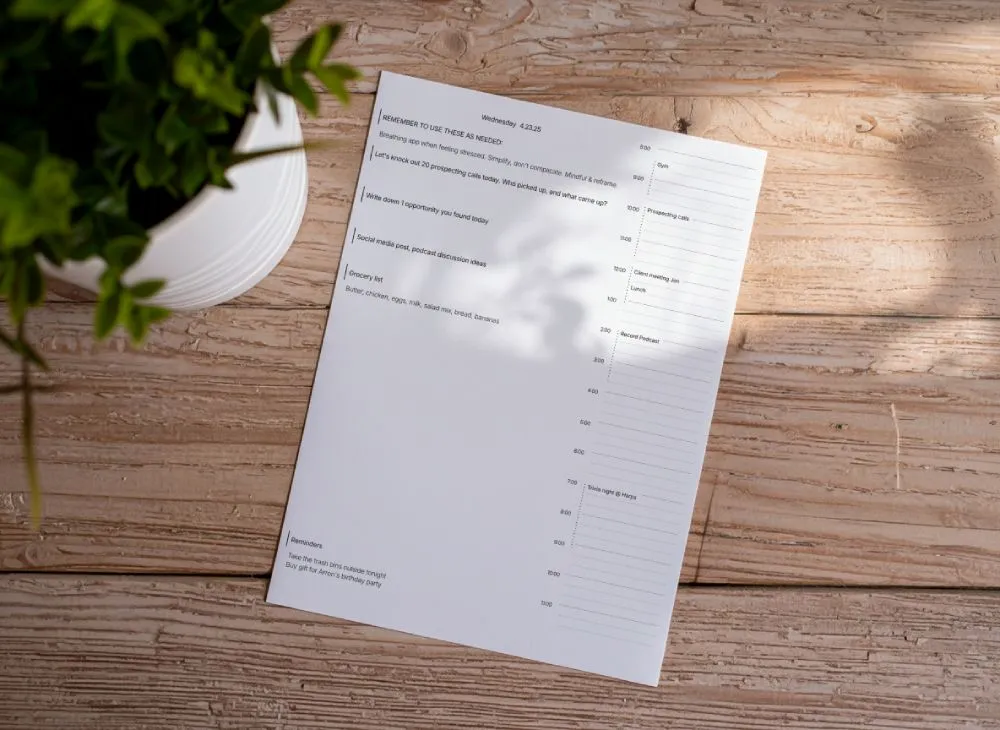
The biggest advantage to this is that they get a printed design that is completely specific to them, as the app pulls in data from the user’s digital life like their calendar and reminders apps, as well as what they create in the Wiseday app.
This results in a daily log that already has structure, and elements like the timeline print with events from the user’s calendar.
It benefits the user by making planning conveniently digital but still allowing execution on paper, giving the advantages of both mediums.
One of the benefits of digital planning is automation. The user can keep themselves accountable to their goals without having to remember everything each day.
This results in much less friction when trying to pickup a planning habit. Whereas traditional BuJo users have to flip through pages and write the daily page by hand, a Wiseday user simply presses print and everything is already setup, allowing for immediate execution on tasks.
The other appeal of this is the physical medium — a single sheet of paper carried day to day has several advantages:
- More inviting. It has a design that is created just for you, compared to a blank or generic planner. This makes it fun and easy to get started writing.
- It is easier to carry. While most bullet journals don’t easily fit in a pocket, one folded sheet of paper fits easily which is important for those who don’t carry bags in their day-to-day.
- Less constrictive. Writing in a fancy expensive journal causes some to judge whether thoughts belong or not, defeating the purpose. Printer paper doesn’t cause this.
- More space. Most bullet journals are half the size of a sheet of printer paper. This can create friction with having to use multiple pages for one day.
BuJo concepts and their equivalent in Wiseday
Future log & Monthly Log
The Wiseday equivalent is the sync between your Calendar and Reminders app that come default on iPhones.
Create events in your calendar as normal and they will show up on the timeline of the daily page.
Future todos go into the Reminders app. Add a due date to them, and they will start printing on your daily pages when they become due (or overdue.)
Collections
The Wiseday equivalent are Prompts. Just like collections in BuJo, a prompt in Wiseday can have many different uses.
A prompt has 3 key elements:
The prompt text (this is the headline)
The subtext
The recurrence (when this prompt should show)
This allows you to create themed lists and trackers that show up on the days you need them, in the order that’s right for you.
Here are some real life examples and how you would set them up:
Morning routine checklist
Prompt text would be “Morning routine”
Subtext would be your routine. You can easily update this in “Today’s prompts.”
Recurrence would be “Every day.”
Make sure to order your prompts list with this on top so it shows up first on your daily page.
Errands list
The purpose of this list is to capture things that are one off (so no need to create them as recurring prompts or reminders,) not due by a certain date (so no need to add them to the Reminders app,) and are miscellaneous (does not fall under any other list.)
The prompt text would be something like “My Errands”.
The subtext (which is easy to update day-to-day) would contain your list.
Recurrence could be “every day,” or if you only have certain days you run errands, then something like “Mondays” or “Weekends.”
Haircut reminder
Reminder text: Get a haircut (or schedule an appointment)
Recurrence: “Every 2 weeks on Wednesday”
Habit tracker
Since prompts and reminders in Wiseday recur, they are great for tracking your habits which may span between different prompts and reminders you have. For example, meditation might be in your Morning Routine Checklist prompt, which you would track by crossing off.
Since prompts and reminders are great at creating habits, let me show you several approaches we could take If we want to use going to the gym as the habit to develop.
The lightest approach would be to create a Wiseday reminder
Reminder text: Go workout
Recurrence on “Monday, Wednesday, and Friday”
The medium approach would be to create a prompt, that would try to motivate us to take action and ask us for details
Prompt text: It’s the day you get to MOVE! Think about how much you are transforming and what you’ll look like in just a month from now if you go today. Write down how it went (energy, any new personal bests?):
Subtext: Drive to the gym and do our stretching routine first (arms, shoulder, head, hips, legs.) Then follow the fitness routine for today.
Recurrence on “Monday, Wednesday, and Friday”
Display Set “Extra writing space” to 2 or 3, so that the prompt prints with extra blank space for you to write about your workout
The heavy duty approach would be to create a single prompt for each day of your workout split. I’ll just use an example for one day below:
Prompt text: Today is BACK and ARMS day. Focus on full contraction and mind-muscle connection. Rate your workout out of 10 below
Recurrence on “Monday”
(Make again for Wednesday Chest and Triceps day, Friday Leg Day)
Wiseday is a daily page, if you wanted to have a monthly graph / tracker like in BuJo, you would create that manually on a separate piece of paper.
Journaling
Prompts are also great at getting yourself to write (and therefore, reflect) about things.
Just set the recurrence to a pattern that makes sense and bump up the “Extra writing space” as necessary to have your pages contain sections to write.
You of course also have plenty of blank space (including the back!) to just brain dump.
Reflection
Just like BuJo, there is a recommended reflection process. Save the pages in a folder, and review them on a weekly or monthly cadence. Get some blank printer pages and write a summary, keep track of habits and goals, and plan the next week or month.
You can bind the pages together using a stapler, or a hole punch and binder rings. This allows you to create booklets for each month.
Summary
As you can see, the BuJo principles and Wiseday have a lot in common, and both can serve the same needs.
Whether you choose BuJo or Wiseday is a matter of preference with regards to format. Wiseday is a hybrid digital and paper system that uses daily pages while BuJo is a manual, paper only system.
You can give Wiseday a try here.